
Fed Interest Rate Decisions: What They Mean for Small Businesses—and What to Do Next
The Federal Reserve does not set your business loan rate directly, but its decisions ripple through credit costs, consumer spending, investment returns, and business confidence. Understanding that chain can help owners make better financing and cash-flow decisions before conditions change.
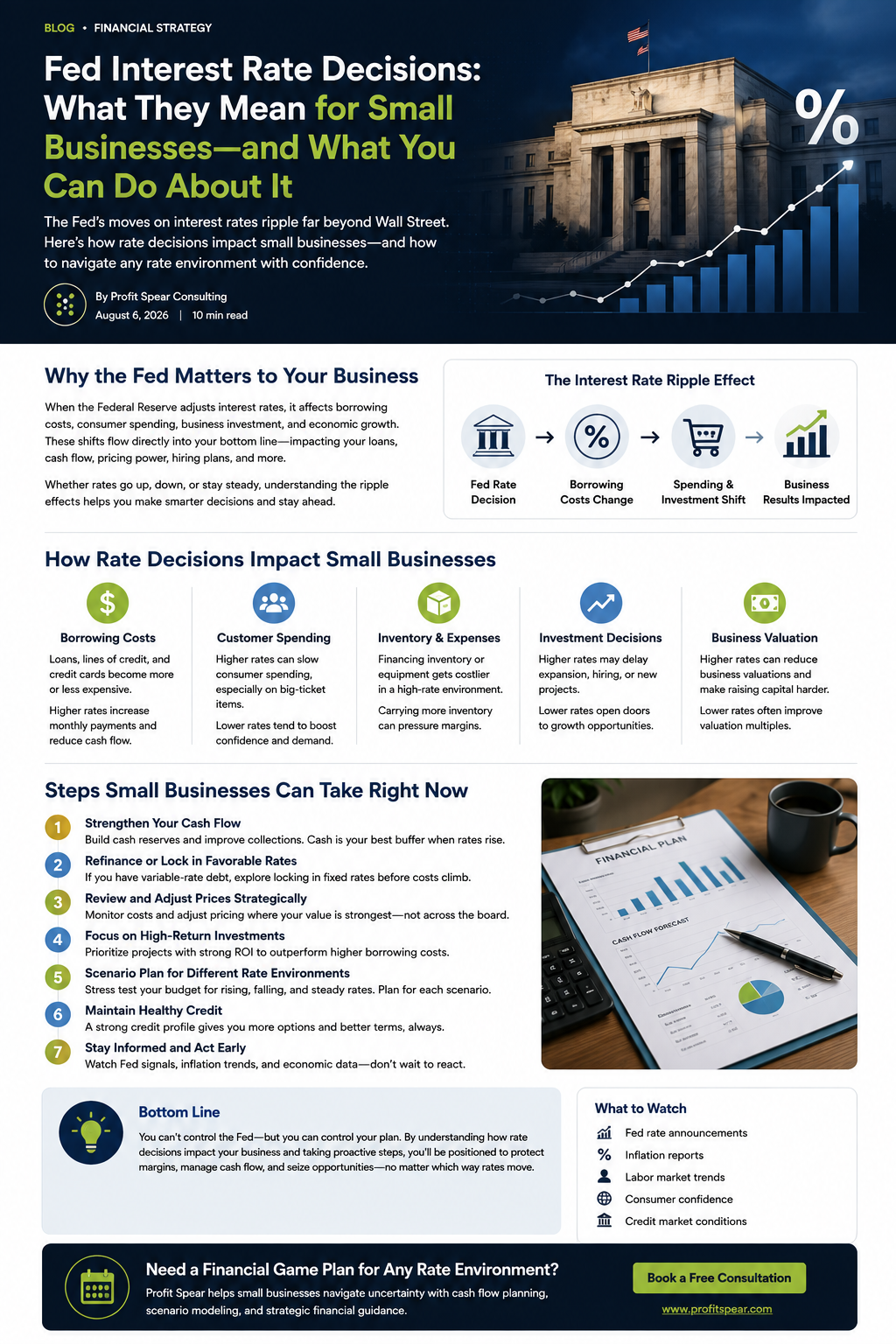
For a small business owner, a Federal Reserve announcement can seem distant from day-to-day operations. In reality, rate decisions can affect the cost of a line of credit, the affordability of equipment financing, customer demand, inventory carrying costs, acquisition valuations, and whether a planned expansion still earns an acceptable return.
At its July 29, 2026 meeting, the Federal Open Market Committee held the federal funds target range at 3.50% to 3.75%. The decision passed 9–3, with three members preferring a quarter-point increase. The Fed said economic activity remained solid but inflation was still elevated relative to its 2% objective. That combination matters for small businesses because it suggests policymakers remain focused on inflation even while they watch growth and employment.
Why the Fed Matters to Your Business
The federal funds rate is the overnight rate the Fed targets for lending between banks. Your bank does not simply add a fixed markup to that rate and hand it to you, but changes in Fed policy influence other short-term interest rates and broader financial conditions. That, in turn, affects borrowing, saving, investment, housing, and consumer spending.
The interest-rate ripple effect
The impact is rarely immediate or uniform. A company with mostly fixed-rate debt may feel little short-term effect. A business using a variable-rate line of credit could see financing expense change much faster. Consumer-facing companies can also feel the effect indirectly if higher borrowing costs cause households to delay large purchases or trade down.
Five Ways Rate Decisions Can Hit Small Businesses
Variable-rate credit lines, working-capital facilities, credit cards, equipment loans, and refinancing can become more expensive when market rates rise.
Higher rates can reduce discretionary spending and make financed purchases less affordable, particularly for big-ticket products and services.
If inventory is funded with debt, the cost of carrying slow-moving stock rises. More cash may be tied up just when liquidity becomes more valuable.
A project that looked attractive at a lower cost of capital may no longer clear the required return once debt service and financing costs increase.
Higher discount rates and tighter credit conditions can put pressure on valuation multiples, acquisition economics, and the amount buyers can finance.
Seven Steps Small Businesses Can Take Now
Map every piece of debt by rate type
List the balance, rate, maturity date, monthly payment, collateral, and whether the rate is fixed or variable. Owners often know their total debt but not how much of it reprices quickly. That distinction becomes critical when rates move.
Stress-test debt service
Run scenarios at the current rate, 1 percentage point higher, and 1 percentage point lower. Measure the change in interest expense, monthly cash flow, debt-service coverage, and covenant headroom. A scenario does not need to predict the Fed; it needs to show management what breaks first.
Build a rolling 13-week cash-flow forecast
Weekly cash forecasting can expose periods when payroll, inventory purchases, tax payments, debt service, and customer collections collide. The earlier a shortfall is visible, the more options management has to fix it.
Refinance selectively—not automatically
A fixed rate can create certainty, but locking in debt also has costs. Compare the all-in rate, fees, prepayment terms, collateral requirements, and remaining term. Refinance when the economics improve risk-adjusted cash flow, not simply because headlines predict future rate changes.
Raise the hurdle rate on growth projects
For equipment, new locations, acquisitions, or major technology investments, update the financing assumptions. Calculate whether expected cash flow still produces an acceptable return after higher debt costs and a reasonable downside case.
Protect credit quality before you need money
Maintain clean financial statements, timely tax filings, adequate liquidity, and clear forecasts. Stronger financial reporting can improve lender confidence and give the business more negotiating leverage when financing is actually needed.
Watch customer sensitivity as closely as interest expense
The indirect demand effect can be larger than the direct borrowing effect. Track order volume, average ticket, conversion rates, cancellations, receivable aging, and customer financing activity. If demand softens, adjust inventory, staffing, and spending before the P&L fully reflects the change.
Plan for Three Rate Environments
| Scenario | Likely business pressure | Management priority |
|---|---|---|
| Rates rise | Higher debt service, tighter credit, weaker financed demand | Preserve cash, control leverage, reprice projects and inventory |
| Rates stay elevated | Financing remains expensive for longer than expected | Improve margins, shorten cash cycles, demand higher ROI from investments |
| Rates fall | Refinancing opportunities improve, but a slowdown may be part of the reason rates are falling | Evaluate refinancing while continuing to stress-test customer demand |
This last scenario is especially important. Owners sometimes assume rate cuts are automatically good news. Lower rates can improve financing economics, but they may also arrive because policymakers see weaker growth or softer labor markets. A business should therefore monitor both the financing benefit and the demand environment.
What to watch between Fed meetings
The Fed repeatedly emphasizes that future decisions depend on incoming data and the evolving outlook. For a small business, five indicators are especially useful:
- Inflation reports and input-cost trends
- Labor-market conditions and wage pressure
- Customer demand and consumer confidence
- Bank lending standards and credit availability
- Your own cash conversion cycle and debt-service coverage
The Bottom Line
The Fed’s July decision leaves policy rates well below their 2025 level, but borrowing is not cheap and inflation remains above the central bank’s goal. For small businesses, the right response is not to wait for a perfect rate environment. It is to understand where interest rates enter the business model, quantify the exposure, and create decision rules before financing or demand conditions change.
Companies with accurate reporting, disciplined cash forecasting, manageable leverage, and scenario-based planning will generally have more options whether rates rise, stay high, or eventually fall. That flexibility—not a perfect prediction of the next FOMC meeting—is the real financial advantage.
Your 30-day rate-readiness checklist
- Inventory every loan, line of credit, lease, and variable-rate obligation.
- Model interest expense at current rates and ±1 percentage point.
- Update a rolling 13-week cash-flow forecast weekly.
- Recalculate returns on planned capital investments using current financing costs.
- Meet with lenders before a financing need becomes urgent.
- Track customer demand indicators alongside credit-market indicators.
Sources
- Federal Reserve, FOMC statement, July 29, 2026.
- Federal Reserve, Monetary Policy Report, July 2026.
- Federal Reserve, Economy at a Glance — Policy Rate.
- NFIB, Price Pressures Have Eased, but Small Businesses Still Feel the Squeeze, April 8, 2026.
This article is general business information and is not investment, lending, tax, legal, or accounting advice. Financing decisions should be evaluated based on your company’s specific cash flow, risk profile, loan terms, and objectives.